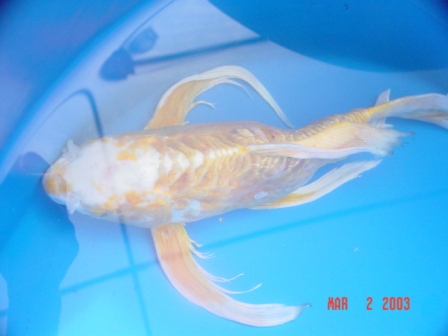
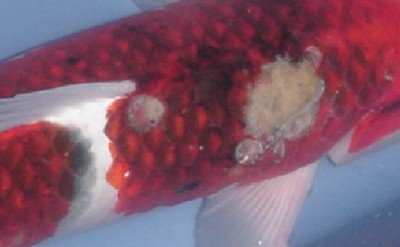
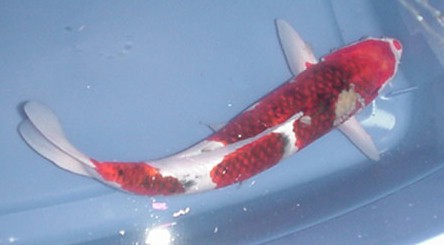
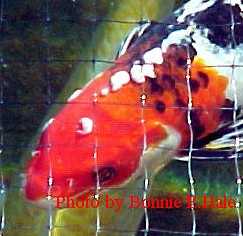
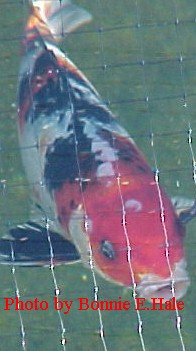
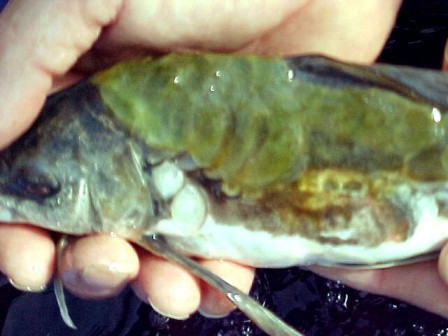
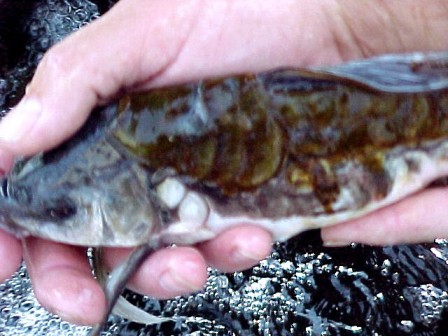
The photos below give
examples of what these maladies will look
like on the fish, followed by a
comprehensive way to treat.
|
|
|
|
|
To the inexperienced it is hard to tell the
difference between fungus, a fungus-looking
bacteria, Saprolegnia and a fungus-looking
parasite. In almost all of these type of
"wounds" one would need a microscope to view
a specimen to see what they are actually
dealing with. All will look different under
the microscope.
So lets break it down
into 3 basic problems.
|
|
Saprolegnia
is cold water mold most often
found in the spring but it can be also found
in the fall when water temperatures are
going down. I have also seen it in the
winter but my gut feeling it was there in
the fall and did not manifest itself until
the water was cold and the fish did not have
the immune system to try to fight it off.
Saprolegnia is the most common of three
problems listed above. Sap appears as white
or tan tufts growing on the skin. It not
uncommon for the Sap to hold algae and for
the area to turn green.
Saprolegnia is a secondary invader. In other
words the fish had a problem to begin with
and the SAP grew on that spot. See the photo
of the fish that was tangled in the net.
|
Also looks like mold but is actually a
parasite. Under the microscope Epistylis
looks like a long slender stalk and a much
wider body.
|
While not as common as Saprolegnia or
Epistylis is also a mold. It looks white or
gray in color but it can also be green in
color because algae will sometimes grow over
the wound. Columnaris bacteria is very hard
to identify without a very high powered
scoped and knowing just what you are looking
for.
|
OK so basically it will be very hard for a
layman to determine just what you are
dealing with so following are some
recommended treatments.
|
First you can try hydrogen peroxide. Soak a
cotton ball in the peroxide and dab the
areas. Take great care to hold the fish so
that you do not get the hydrogen peroxide in
the eyes, mouth or gills.
|
High salt .6%
(6 pounds of salt per 100 gallons) used as
bath for an hour or so.
|
|
Potassium Permanganate (herein referred to
PP) will also work. Baths in PP is rather
complicated and is best left to those who
are very familiar with PP and its use. One
can very easily kill the fish if they do not
know what they are doing.
Alternative treatment #2:
PP scrubs work very well. Simply make a
paste of PP and water. Pond water or tap
water makes no difference because PP is
self-sterilizing. Place PP granules in a
small container with a lid. This can be used
over and over and all you have to do is
replace the lid until the next time you are
ready to use it again. Add enough water to
make a thick paste. Please wear gloves and
eye protection. There is no way to do the
following procedure and you are going to end
up with stains on your hands that will take
several days to wear off. Use a cotton ball
or Q-tip (what you use will depend on the
size of the area) and gently dab the area.
Take great care to hold the fish so that you
do not get the PP in the eyes, mouth or
gills. After dabbing the area rinse the fish
in clean water that is preferably pond/tank
water. No sense stressing the fish by using
tap water that is not the temperature the
fish is used to being in. Only do this
procedure ONE time.
|
|
Malachite
Green also works on fungus but is rather
hard to get. MG is used as a bath in water
that is around 70*. Keep in mind that MG is
very toxic to the fish in very warm water. |
If you do not
see a vast improvement in the fish in 48
hours, try one of the alternative treatments
listed above. The next day if the area does
not look better it is time to try a
different treatment. If the fish does not
show signs of improvements with any of the
above treatments in a few days OR looks
worse, it may be time to do injections of
antibiotics.
|